
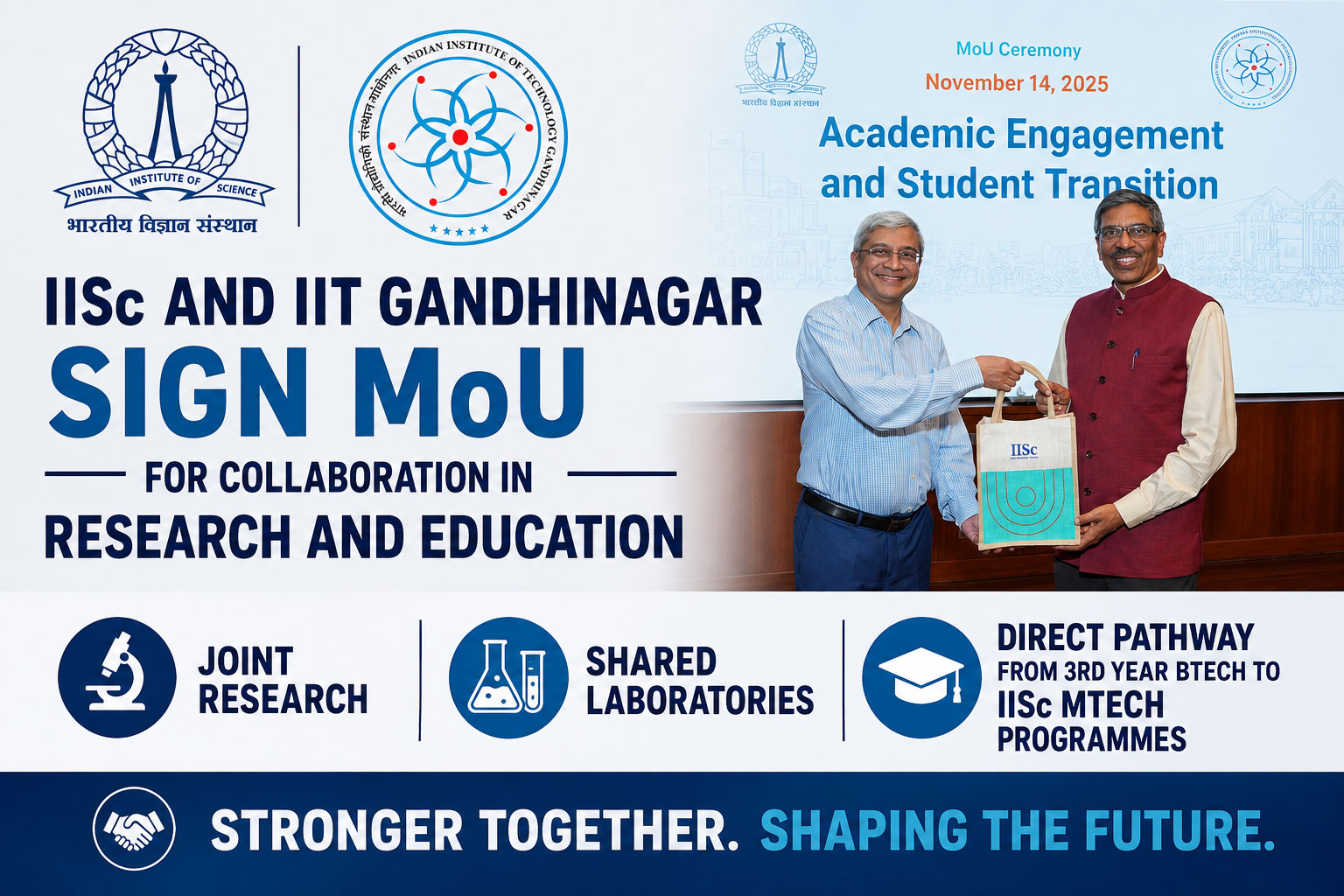
IISc and IIT Gandhinagar sign MoU enabling joint research, shared laboratories and a direct pathway from third-year B.Tech. to IISc. M.Tech. programmes for high-performing students.
A new academic partnership
The Indian Institute of Science (IISc), Bengaluru, and the Indian Institute of Technology Gandhinagar (IITGN) have signed a Memorandum of Understanding (MoU) to strengthen academic exchange and research collaboration. The partnership will bring together the capabilities of two leading Indian institutions and create new opportunities for students, faculty members and researchers.
Under the agreement, students and researchers from both institutes can pursue joint research projects in areas of mutual interest. The institutions will also organise workshops, symposia and other academic activities, while enabling researchers to access laboratories, research infrastructure and specialised facilities at both campuses.
The MoU represents a broader effort to connect India’s premier institutions and promote flexible academic pathways. It will allow IITGN students to engage more closely with IISc’s advanced research ecosystem while giving IISc researchers access to IITGN’s strengths in engineering, technology, design and innovation.
Direct pathway to IISc
One of the most significant features of the partnership will benefit IITGN students who complete their third year of the BTech programme. Eligible students will be able to apply to join IISc directly for a Master’s degree after a competitive selection process.
The arrangement will give high-performing students an opportunity to begin advanced study earlier and move seamlessly from undergraduate education to postgraduate research. Students who fulfil the academic requirements will receive their BTech degree from IITGN and their MTech degree from IISc.
The route does not represent automatic admission. Students must complete the required selection process and meet the academic conditions prescribed by IISc. However, the pathway can simplify progression for students who already demonstrate strong research potential and wish to pursue advanced study in science and technology.
The arrangement could also encourage students to consider research careers at an earlier stage. Instead of waiting until the completion of a four-year undergraduate degree and then applying separately for postgraduate programmes, eligible IITGN students can begin preparing for advanced research while completing their BTech education.
Wide range of MTech specialisations
IISc offers more than two dozen specialisations in its MTech programmes, creating opportunities for students with interests across engineering, computer science, data science, materials, energy, electronics and other emerging fields. A majority of IISc’s research and course programmes remain open for direct admission to graduates from Centrally Funded Technical Institutions (CFTIs), according to Prof G Rangarajan, Director of IISc.
This academic breadth will allow IITGN students to explore fields beyond their original undergraduate specialisation. A student trained in mechanical engineering, for example, may pursue research in computational science, robotics, energy systems or advanced materials, depending on eligibility and selection. Such cross-disciplinary movement has become increasingly important as scientific and technological problems grow more complex.
Research and laboratory access
The MoU will also create opportunities for faculty and students to use facilities at both institutions. Shared access to laboratories can help researchers conduct experiments that require specialised equipment, advanced instrumentation or complementary technical expertise. It can also reduce duplication and encourage teams to combine resources for ambitious projects.
Joint projects may cover areas such as artificial intelligence, advanced materials, sustainable energy, biotechnology, quantum technologies, computational science and engineering systems. The agreement does not restrict collaboration to a single discipline, allowing researchers to identify emerging areas where their expertise overlaps.
Access to infrastructure can prove particularly valuable for early-career researchers and students. They can work with new equipment, interact with researchers from different backgrounds and develop skills that prepare them for doctoral studies or careers in research and development.
Workshops and academic exchange
The two institutes will organise joint workshops, symposia and academic programmes to encourage knowledge sharing. These events can bring together faculty members, doctoral scholars, postgraduate students and industry representatives to discuss new findings and identify areas for collaboration.
Student exchange will form another important component of the partnership. IITGN students will have opportunities to visit IISc for academic and research programmes, while the institutions can explore additional forms of mobility in the future. Such exchanges expose students to different teaching environments, research cultures and approaches to problem-solving.
Faculty visits can strengthen the partnership further. Professors and researchers can spend time at the partner institution, supervise projects, deliver lectures and develop joint proposals. These interactions often provide the foundation for long-term collaborations, including co-authored publications, shared grants and joint doctoral supervision.
IISc’s perspective
Prof G Rangarajan, Director of IISc, said the institute was excited to begin the partnership with IIT Gandhinagar. He said the collaboration would allow BTech students to transition smoothly to MTech and PhD programmes after their third year of undergraduate studies. He also highlighted IISc’s broad range of MTech specialisations and the availability of direct admission pathways for graduates from CFTIs.
His remarks underline the partnership’s focus on research-led education. IISc aims to attract talented students who can contribute to advanced scientific work, while IITGN students gain a structured route into one of India’s leading research institutions.
Benefits for Indian higher education
The IISc–IITGN partnership reflects the growing importance of institutional collaboration in Indian higher education. No single institute can address every major challenge in areas such as climate change, public health, clean energy, cybersecurity or advanced manufacturing. Partnerships allow institutions to share expertise, infrastructure and talent.
The agreement also supports the national goal of developing a stronger research ecosystem. By encouraging student mobility and joint projects, it can help create a larger pool of researchers trained to work across disciplines. It may also support India’s efforts to translate academic research into technologies and solutions with social and economic value.
A gateway to advanced research
The MoU opens a new gateway for IITGN students who want to pursue advanced research at IISc. It also creates a structured foundation for sustained collaboration between faculty members and research groups at both institutions.
As the two institutes begin implementing the agreement, the success of the partnership will depend on the number and quality of joint projects, exchanges and academic programmes they develop. If effectively executed, it could become a model for research-oriented collaborations among India’s premier institutions.
IISc #IITGandhinagar #AcademicCollaboration #ResearchPartnership #StudentExchange #MTechAdmissions #BTechToMTech #HigherEducation #JointResearch #IndianScience
Disclaimer
The information in this article is based on available public sources and official statements as of the time of publication. While we aim for accuracy, we do not guarantee completeness or correctness. We advise readers to verify key details from official sources before making any decisions. The website (iitiimsamvaad.com) is not liable for any loss or damage arising from the use of this content. The authors are also not responsible for any such loss or damage.