
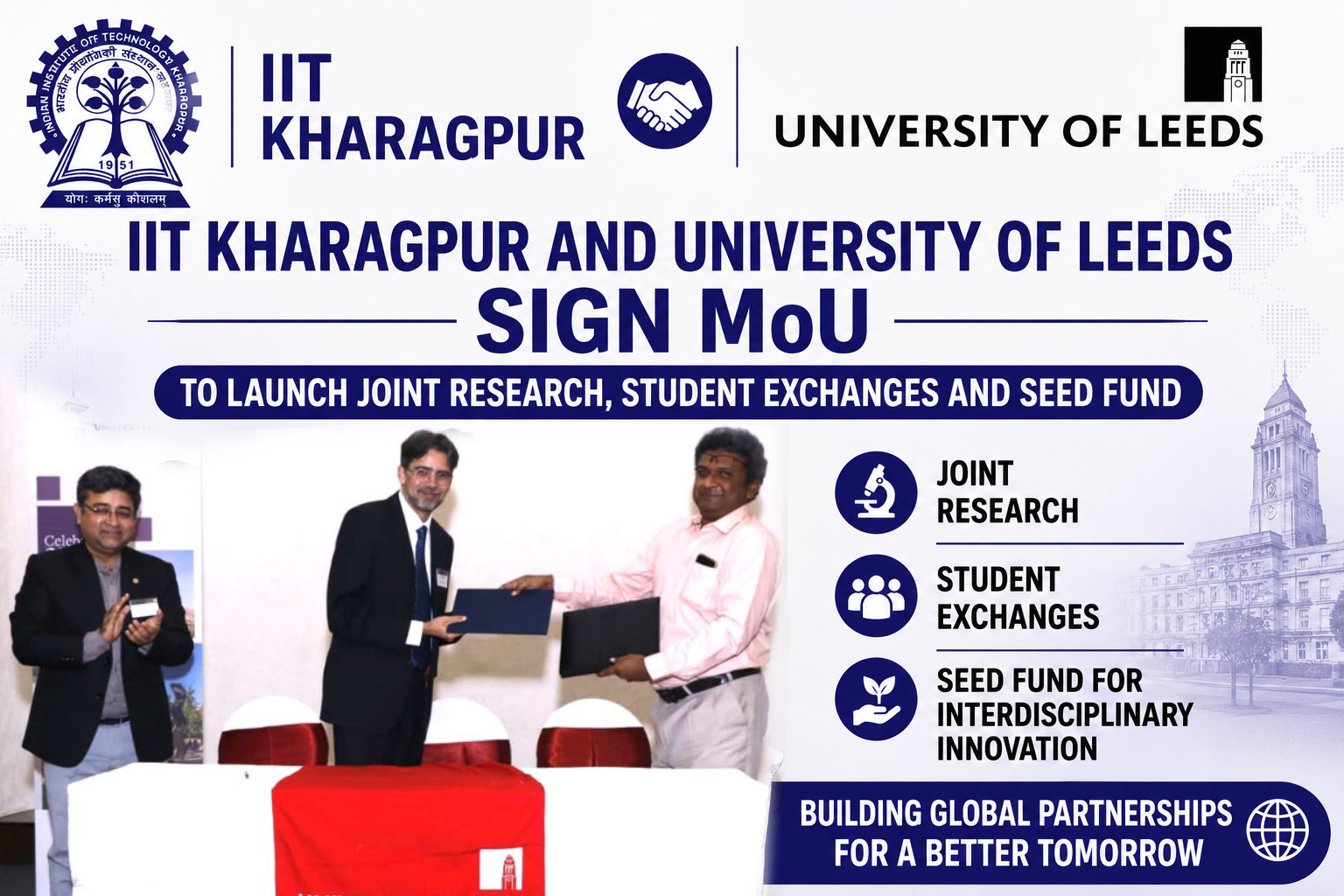
IIT Kharagpur and the University of Leeds sign an MoU to launch joint research, student exchanges and a seed fund for interdisciplinary innovation.
A strategic global partnership
The Indian Institute of Technology (IIT) Kharagpur signed a Memorandum of Understanding (MoU) with the University of Leeds to establish a long-term strategic partnership focused on advancing interdisciplinary research, fostering academic collaboration and accelerating innovation. The MoU brings together the strengths of two globally recognised institutions and creates a framework for joint work across research, education and innovation. Both sides said the partnership will help address pressing societal, technological and economic challenges through coordinated research, shared teaching initiatives and deeper international engagement.
The agreement signals IIT Kharagpur’s continued push to expand its global network. It also reflects the University of Leeds’ strategy to deepen ties with leading Indian institutions in science, engineering and technology. By aligning their priorities, the two universities aim to create opportunities for faculty, students and researchers that go beyond short-term exchanges.
Joint seed fund for pilot projects
As part of the collaboration, the two institutions will establish a jointly funded seed fund supported by matched contributions of up to USD 50,000 from each side. The fund will enable researchers to pursue pilot projects, test innovative ideas and develop proposals for larger-scale national and international funding opportunities. The University of Leeds has already allocated and utilised its contribution to support the initial phase of collaborative activities under the partnership, while IIT Kharagpur has pledged its contribution for the current year.
That seed funding matters because it lowers the barrier for early-stage collaboration. Researchers can use it to explore high-risk, high-reward ideas, collect preliminary data and build teams before applying for major grants. Over time, successful pilot projects can evolve into larger joint programmes, co-supervised PhDs and multi-institution consortia. The fund also encourages interdisciplinary work, as teams from different departments can combine expertise to tackle complex problems.
Education and student mobility
The MoU establishes a framework for collaboration across research, education and innovation. Both institutions will explore opportunities to develop joint undergraduate, postgraduate and research-led teaching initiatives. That could include co-designed courses, joint modules, virtual classrooms and shared project work. Students and researchers will gain access to diverse academic perspectives and international learning experiences without necessarily relocating for long periods.
The partnership will also promote faculty visits, student exchange opportunities and research mobility programmes. These activities strengthen academic engagement and foster deeper collaboration between researchers and educators. For students, short-term exchanges and joint projects offer exposure to different pedagogical styles, research cultures and industry links. For faculty, visits and joint teaching help build lasting networks that can lead to co-authored papers, shared grants and co-supervised doctoral students.
Interdisciplinary research focus
The partnership will support interdisciplinary research across a range of fields, encouraging collaboration on complex global challenges through joint projects and knowledge exchange. Potential areas of focus may include climate change, sustainable infrastructure, health technologies, data science, advanced materials and smart manufacturing. Both IIT Kharagpur and the University of Leeds have strong capabilities in engineering, physical sciences and applied research, which creates natural synergies for joint work.
By linking complementary strengths, the two universities can tackle problems that require both technical depth and systems thinking. For example, a joint project might combine IIT Kharagpur’s expertise in civil engineering and water resources with Leeds’ strengths in environmental modelling and policy. Another might pair data science and AI groups from both sides to work on health analytics or industrial automation. The MoU provides the structure to make such collaborations easier to initiate and sustain.
Leadership perspectives
Professor Vassilis Sarhosis, Director of Internationalisation at the University of Leeds, said the partnership is important for both institutions. He noted that working together will enable them to advance world-class research, provide opportunities for talented students and play an effective role in solving global problems. His remarks underline the strategic nature of the collaboration, which goes beyond individual projects to shape long-term institutional ties.
Professor Anandaroop Bhattacharya, Dean of the Department of International Relations at IIT Kharagpur, said international collaboration is crucial for research excellence and for creating new opportunities in education. He added that the partnership with the University of Leeds will bring together the expertise and experience of both institutions and pave the way for research, innovation and the creation of effective solutions for the development of society and the economy. That statement positions the MoU as a platform for both academic and societal impact.
Strengthening India–UK academic ties
The partnership establishes a foundation for long-term collaboration between the University of Leeds and IIT Kharagpur. It creates new opportunities for students, researchers and faculty while strengthening academic and research ties between India and the United Kingdom. Through joint initiatives, academic mobility programmes and collaborative research activities, both institutions aim to drive innovation, expand knowledge and contribute to addressing global challenges.
For IIT Kharagpur, the MoU adds another important node to its growing international network. For the University of Leeds, it deepens engagement with India’s research ecosystem at a time when UK universities seek stronger links with Asian partners. The collaboration also aligns with broader government-level efforts to enhance science and technology cooperation between the two countries.
From agreement to impact
The real test of the MoU will lie in execution. Both sides must now translate the framework into concrete projects, courses and exchanges. The seed fund provides an immediate mechanism to kick-start collaboration, but sustained impact will depend on active participation from faculty, clear priorities from leadership and support from administrative teams. Over time, successful joint outputs – papers, patents, startups, policy recommendations – will validate the partnership.
If the collaboration delivers on its promise, it could serve as a model for other IIT–UK university partnerships. It shows how two institutions can move beyond generic MoUs to create structured, funded and outcome-oriented cooperation. In that sense, the IIT Kharagpur–Leeds partnership is not just an agreement; it is a blueprint for future global academic collaboration.
IITKharagpur #UniversityOfLeeds #MoU #InternationalCollaboration #JointResearch #StudentExchange #SeedFund #InterdisciplinaryResearch #IndiaUK #HigherEducation
Disclaimer
The information in this article is based on available public sources and official statements as of the time of publication. While we aim for accuracy, we do not guarantee completeness or correctness. We advise readers to verify key details from official sources before making any decisions. The website (iitiimsamvaad.com) is not liable for any loss or damage arising from the use of this content. The authors are also not responsible for any such loss or damage.