

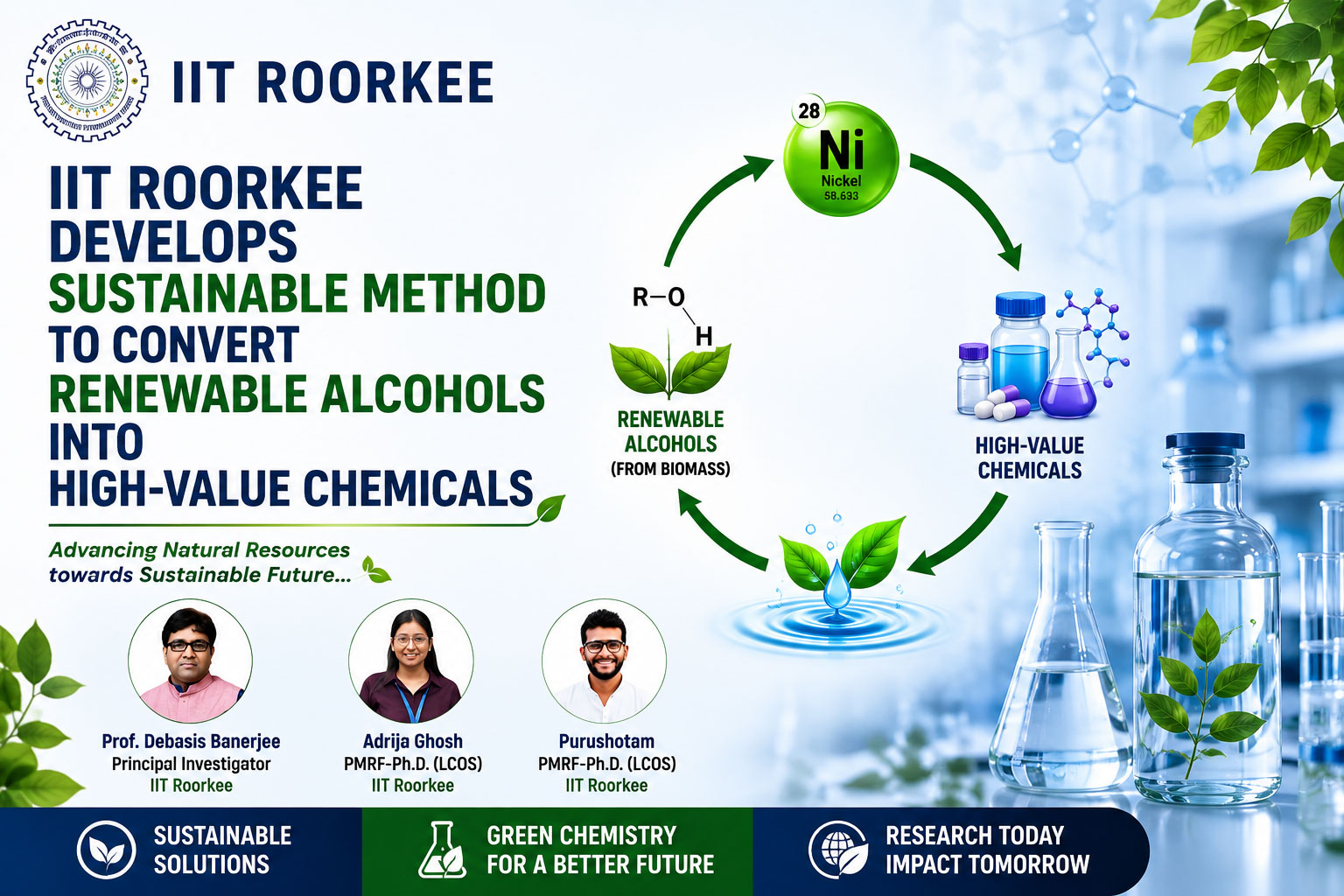
IIT Roorkee researchers develop a nickel-catalysed method that converts renewable alcohols into highly selective olefins and dienes for medicines and advanced materials for industry.
A greener route to complex chemicals
Researchers at the Indian Institute of Technology Roorkee have developed a sustainable catalytic method that converts renewable alcohols into complex organic molecules used in pharmaceuticals and advanced organic materials. The study, published in Nature Communications, demonstrates how biomass-derived feedstocks and an earth-abundant nickel catalyst can support highly selective chemical synthesis.
Led by Prof Debasis Banerjee from the Department of Chemistry at IIT Roorkee, the research introduces a ligand-enabled nickel catalytic process for producing trisubstituted olefins and 1,3-dienes. These molecules serve as important building blocks in medicinal chemistry, materials science and industrial chemical manufacturing.
The method addresses two major concerns in conventional chemical synthesis: the dependence on expensive catalysts and the need for multiple reaction steps. By using renewable alcohols and a commercially available nickel catalyst, the researchers have created a modular approach that could make the production of valuable molecules more economical and environmentally responsible.
Why renewable alcohols matter
Alcohols derived from biomass offer an attractive alternative to fossil-based chemical feedstocks. Researchers can obtain them from renewable biological sources, including agricultural residues, plant-based materials and other biomass streams. However, scientists must develop efficient methods to convert these relatively simple molecules into complex structures with controlled properties.
Traditional synthesis often requires several steps, protecting groups and precious-metal catalysts. Each additional step consumes energy and chemicals and generates waste. Precious metals can also increase costs and create supply-chain concerns. The IIT Roorkee team’s method uses nickel, which is more abundant and economical than many precious metals, while achieving high levels of selectivity.
The process also supports the principles of green chemistry by reducing the number of synthetic operations and using renewable starting materials. Its modular design allows researchers to combine different alcohols and generate a broad range of products.
Producing olefins and dienes selectively
The team used the catalytic process to synthesise 27 trisubstituted olefins with stereoselectivities of up to 98:2 in the E/Z ratio. It also produced 23 highly selective 1,3-dienes with E/Z ratios greater than 20:1. The E and Z designations describe the spatial arrangement of groups around a carbon–carbon double bond, which can influence a molecule’s biological activity, stability and material properties.
High stereoselectivity matters because chemical products with different spatial arrangements can behave very differently. Pharmaceutical manufacturers often need one particular form of a molecule, while materials researchers require precise structures to control strength, flexibility, conductivity or optical performance. A process that produces the desired arrangement directly can reduce the need for additional purification and processing.
The researchers also demonstrated the versatility of the method through late-stage functionalisation. This approach allows scientists to modify complex molecules near the final stage of synthesis rather than rebuilding them from the beginning.
Testing the method on valuable molecules
The team applied the catalytic process to biologically relevant compounds such as DL-galactose and α-tocopherol, commonly known as Vitamin E. These experiments showed that the reaction could operate on structurally complex molecules containing multiple functional groups.
The researchers also synthesised a tamoxifen analogue and polyaromatic hydrocarbons. The tamoxifen analogue demonstrated the method’s relevance to medicinal chemistry, while the polyaromatic products highlighted its potential in materials research. These examples showed that the process could generate molecules with value beyond simple laboratory demonstrations.
By successfully modifying diverse substrates, the team established that the method can support a wide range of applications. Researchers could potentially adapt the platform to synthesise intermediates for drug discovery, advanced polymers, electronic materials and functional organic compounds.
Understanding the reaction mechanism
The IIT Roorkee researchers did not stop at developing the reaction. They also investigated the molecular-level mechanism that drives the catalytic transformation. These studies provided insights into how the nickel catalyst, ligand and alcohol substrates interact during the process.
Mechanistic understanding helps researchers predict how a reaction will behave with new starting materials. It can also guide the design of improved catalysts that operate at lower temperatures, require smaller quantities of metal or deliver higher yields. The mechanistic findings may therefore support future catalytic systems based on renewable feedstocks. pib.gov
Prof Debasis Banerjee said the team aimed to develop a catalytic platform that could convert readily available renewable alcohols into structurally complex and industrially valuable molecules with high selectivity. He added that the study offers both an efficient synthetic methodology and mechanistic insights for designing future sustainable reactions.
Significance for green chemistry
Prof K. K. Pant, Director of IIT Roorkee, said fundamental chemistry research plays an important role in enabling cleaner and more sustainable technologies. He noted that the publication in Nature Communications reflects IIT Roorkee’s commitment to high-quality research addressing global scientific challenges.
The study aligns with the global shift towards green chemistry, which prioritises renewable feedstocks, energy-efficient processes, safer catalysts and reduced chemical waste. Replacing precious metals with nickel can lower the material cost of chemical synthesis and improve the accessibility of advanced catalytic technologies.
However, laboratory success does not automatically guarantee industrial adoption. Researchers will need to assess the process at larger scales, evaluate catalyst recovery, measure energy consumption and examine the economics of using different biomass-derived alcohols. Further work will also determine how the method performs in continuous manufacturing systems.
Collaboration and future directions
Adrija Ghosh and Purushotam from IIT Roorkee carried out the research in collaboration with Prof Chao-Jun Li of McGill University, Canada. The Ministry of Education’s STARS Programme and the Anusandhan National Research Foundation supported the study. The student researchers also received support through the Prime Minister’s Research Fellowship.
As industries seek cleaner and more resource-efficient manufacturing, the new method expands the toolkit of sustainable synthetic chemistry. It provides a strategy for converting renewable resources into complex molecules with applications in medicines and advanced materials.
The research could inspire further development of nickel-based catalytic systems and encourage scientists to explore a wider range of biomass-derived feedstocks. By combining renewable raw materials, selective chemistry and mechanistic understanding, IIT Roorkee has advanced an important pathway towards more sustainable chemical manufacturing.
#IITRoorkee #GreenChemistry #RenewableFeedstocks #NickelCatalysis #SustainableChemistry #NatureCommunications #BiomassDerivedChemicals #Olefins #AdvancedMaterials #PharmaceuticalChemistry
Disclaimer
The information in this article is based on available public sources and official statements as of the time of publication. While we aim for accuracy, we do not guarantee completeness or correctness. We advise readers to verify key details from official sources before making any decisions. The website (iitiimsamvaad.com) is not liable for any loss or damage arising from the use of this content. The authors are also not responsible for any such loss or damage.