

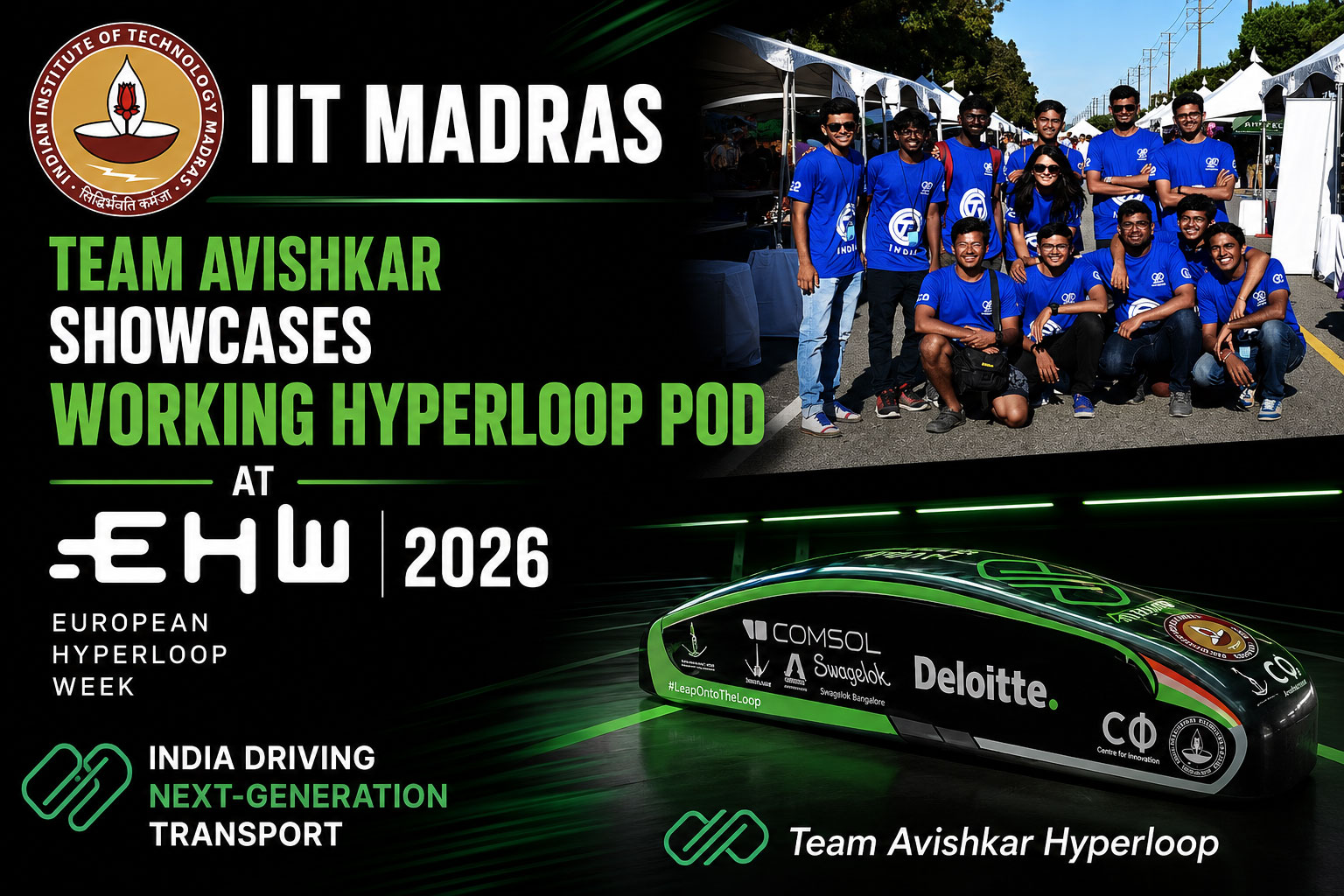
IIT Madras’s Team Avishkar showcases a working Hyperloop pod at EHW 2026, highlighting India’s growing capabilities in next-generation transport technology.
A milestone for Indian student engineering
A student team from IIT Madras has successfully demonstrated a working Hyperloop prototype during the European Hyperloop Week (EHW) 2026. The event, held in the Netherlands, brings together university teams from around the world to present vehicles and full-scale pods to a panel of judges. Team Avishkar Hyperloop, the student-led Hyperloop team from IIT Madras’s Centre for Innovation (CFI), represented India at the competition and showcased the country’s growing capabilities in next-generation transportation technology.
While commercial Hyperloop systems remain under development worldwide, innovations like these bring the vision of ultra-high-speed travel one step closer to reality. The IIT Madras prototype demonstrates that Indian engineering talent can compete on a global stage and contribute to one of the most ambitious transport concepts of the 21st century.
The Hyperloop vision
The Hyperloop concept proposes a new mode of transport in which passenger or cargo pods travel inside near-vacuum tubes at very high speeds, potentially exceeding 1,000 km/h. By reducing air resistance and using magnetic levitation or low-friction systems, the technology aims to offer travel times comparable to short-haul flights but with lower energy consumption and emissions. Several companies and research groups around the world continue to explore different technical approaches to make this vision practical.
Student competitions such as European Hyperloop Week play a crucial role in this ecosystem. They provide a platform for young engineers to test ideas, build prototypes and receive feedback from experts. Over time, these projects also generate valuable knowledge about pod design, propulsion, braking, control systems and vacuum infrastructure. That knowledge feeds into larger efforts by startups, rail operators and governments to evaluate Hyperloop feasibility.
Team Avishkar’s journey
Team Avishkar Hyperloop began as a student project at IIT Madras’s Centre for Innovation and has evolved into an internationally recognised team. Over the years, the group has transformed ambitious ideas into reality, moving from early sketches and CAD models to functional pods and test tracks. The team describes its journey as one of curiosity, resilience and shared belief that the future of transportation can be built at IIT Madras.
In previous editions of European Hyperloop Week, the team earned recognition for scalable design and finished in the global top five in certain categories. It also signed an MoU with Indian Railways, which supported the development of Asia’s largest student-run Hyperloop test track, spanning more than 400 metres on the IIT Madras Discovery Campus. That facility also allows the team to test levitation, propulsion, braking and control systems in near-vacuum conditions.
The 2026 prototype and competition
For EHW 2026, Team Avishkar built a new vacuum-compatible Hyperloop pod designed for enhanced performance in near-vacuum conditions. The team worked on levitation, propulsion, braking and control systems, and ran vacuum tube tests at IIT Madras to prove performance and safety before shipping the pod to the competition. The effort required close coordination between mechanical, electrical, software and systems sub-teams, as well as support from faculty, alumni and industry mentors.
At the event, the team presented its pod to judges and peers, competed in several categories and demonstrated key subsystems. While the competition focuses on student innovation rather than full-scale commercial deployment, it validates design choices, highlights engineering challenges and builds confidence that such systems can work in practice. For Team Avishkar, participation in EHW 2026 represents both a technical milestone and a statement of intent.
Building a test ecosystem in India
Beyond the competition, Team Avishkar has invested heavily in building a test ecosystem in India. The team’s 400–500 metre vacuum tube facility at IIT Madras is among the largest student-run Hyperloop test tracks in the world. It allows the group to conduct iterative testing, refine designs and train new members without depending solely on overseas facilities. That infrastructure also attracts attention from industry partners, government agencies and researchers interested in high-speed transport.
The Railway Minister’s support and the MoU with Indian Railways signal institutional recognition of the team’s work. While a commercial Hyperloop corridor in India remains a long-term possibility, the immediate value lies in capability building. The team develops skills in vacuum engineering, magnetic systems, control algorithms and safety protocols – capabilities that can feed into broader rail, aerospace and advanced manufacturing sectors.
From student project to future impact
The Hyperloop prototype does not mean that ultra-high-speed tubes will appear on Indian maps tomorrow. Commercial deployment will require breakthroughs in cost, safety, regulation and public acceptance. Yet student projects like Team Avishkar’s play a vital role in that journey. They also keep the concept alive, test critical technologies and inspire the next generation of engineers to think boldly about transport.
For IIT Madras, the achievement reinforces its reputation as a hub for innovation and deep-tech student projects. For India, it showcases engineering talent that can contribute to global conversations on future mobility. As Team Avishkar continues to iterate on its pod and test track, it moves the Hyperloop vision from paper to progress, one prototype at a time.
#IITMadras #Hyperloop #TeamAvishkar #EuropeanHyperloopWeek #FutureTransport #CentreForInnovation #StudentInnovation #HighSpeedTravel #IndianEngineering #NextGenMobility
Disclaimer
The information in this article is based on available public sources and official statements as of the time of publication. While we aim for accuracy, we do not guarantee completeness or correctness. We advise readers to verify key details from official sources before making any decisions. The website (iitiimsamvaad.com) is not liable for any loss or damage arising from the use of this content. The authors are also not responsible for any such loss or damage.