

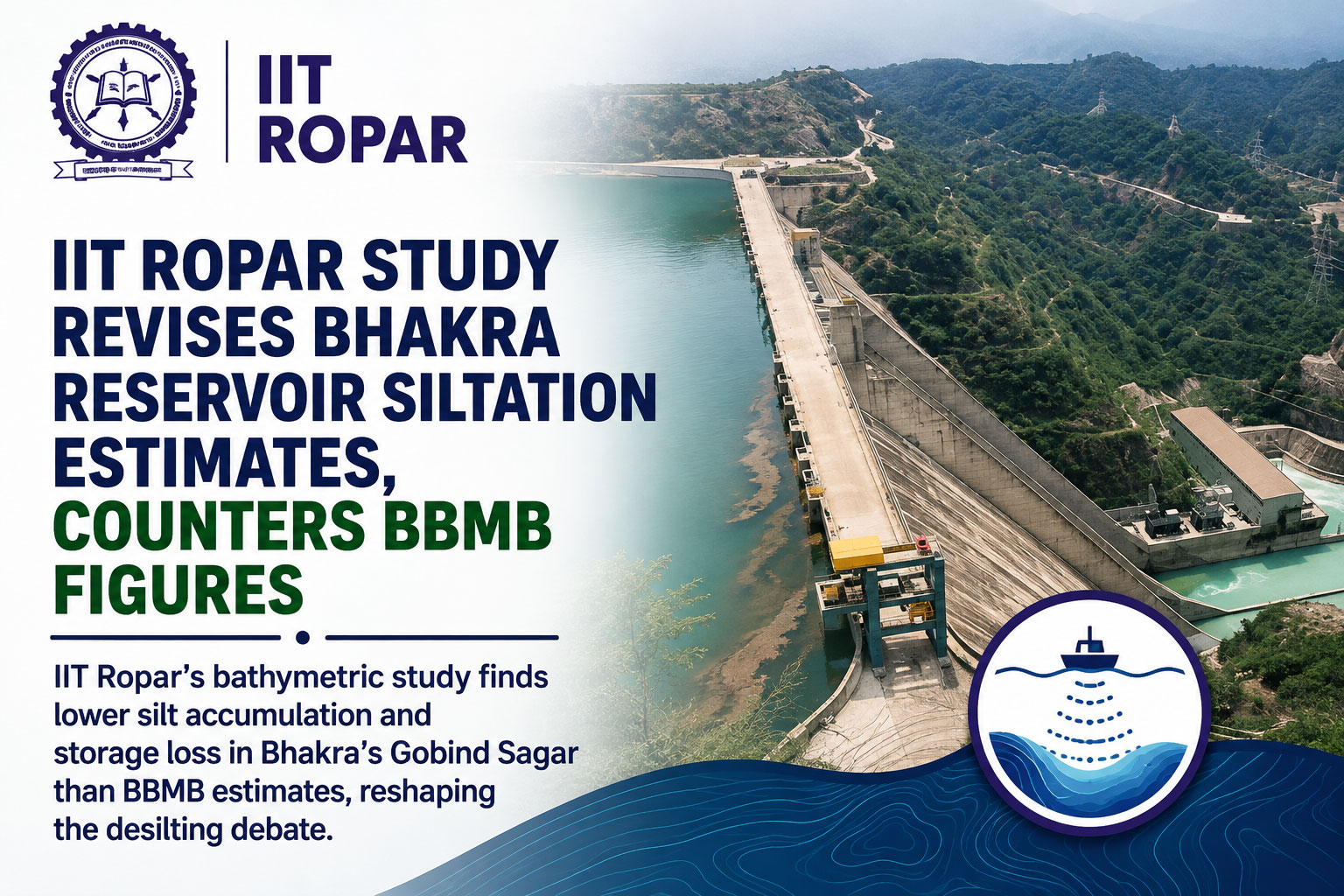
IIT Ropar’s bathymetric study finds lower silt accumulation and storage loss in Bhakra’s Gobind Sagar than BBMB estimates, reshaping the desilting debate.
A new assessment of Bhakra’s siltation
A study by the Indian Institute of Technology (IIT) Ropar has challenged the Bhakra Beas Management Board’s (BBMB) estimates on silt accumulation and storage loss in the Gobind Sagar reservoir of the Bhakra Dam. Led by Dr Reet Tiwari, the IIT team concluded that the reservoir has retained significantly more of its storage capacity than BBMB studies claimed. The findings assume importance as BBMB has initiated the process for the first-ever large-scale desilting of the Gobind Sagar reservoir since the dam became operational in 1959.
The report, accessed by The Tribune, estimates the overall capacity loss of the reservoir at 38%, compared to the 47% estimated by BBMB. It also reports that the loss of live storage stands at 13%, considerably lower than the 19% assessed by BBMB. Similarly, the IIT study pegs the loss of gross storage at 19%, against the 26% estimated by BBMB. These revised figures suggest that the reservoir may be in better condition than previously assumed, at least in terms of available storage.
Lower annual silt inflow estimates
The research also contradicts BBMB’s assessment of annual silt inflows into the reservoir. While BBMB has estimated that the Bhakra reservoir receives around 39 million cubic metres (MCM) of silt annually, the IIT Ropar scientists have assessed the inflow at 31 MCM. That figure is even lower than the reservoir’s original design estimate of 33.61 MCM per year. If accurate, the lower inflow rate implies that sedimentation may be progressing more slowly than BBMB’s planning assumptions suggest.
That difference matters for long-term reservoir management. Overestimating silt inflow can lead to premature conclusions about storage loss and may justify costly desilting interventions earlier than necessary. Underestimating it, on the other hand, can delay action until the reservoir loses critical functionality. The IIT study pushes the debate toward a more data-driven assessment of how fast Gobind Sagar is filling with sediment and what that means for irrigation, power and flood control.
Why the estimates differ
Senior BBMB officials attributed the variation in findings to the advanced survey techniques adopted by the IIT team. Speaking on the condition of anonymity, they said the institute had used modern bathymetric surveys, drone-based mapping and much denser cross-sectional measurements to assess sediment deposits. According to the officials, the IIT scientists conducted surveys at intervals of about 30 metres, enabling them to capture finer variations in the reservoir bed. In contrast, BBMB’s conventional surveys relied on cross-sections spaced approximately 610 metres apart.
The use of advanced technology and higher-resolution mapping, they said, resulted in more precise estimates of sediment accumulation. That explanation suggests that the IIT study does not necessarily contradict BBMB’s earlier work so much as refine it with better data. It also highlights how technological improvements in surveying can change our understanding of long-term infrastructure performance. For a dam as old and critical as Bhakra, that refinement has major implications for planning and investment.
Desilting plans in motion
The contrasting findings have emerged at a crucial stage, with BBMB moving ahead with an ambitious plan to desilt the Gobind Sagar reservoir. The Board has already floated an Expression of Interest (EoI) for mechanical desilting at Lunu in Bilaspur district and Seer Khad in Una district of Himachal Pradesh. Officials estimate that nearly 150 MCM of silt is available for excavation at each site. The contractor executing the work will be responsible for obtaining environmental clearances and other statutory approvals.
Himachal Pradesh has agreed to the proposal and will receive a royalty of around Rs 150 per tonne on the extracted material. If higher commercial value is realised from the excavated silt, the additional revenue may be shared among BBMB partner states Punjab, Haryana and Rajasthan. That revenue-sharing model aims to make desilting financially viable while distributing benefits across the command area. However, the IIT study’s lower estimates of silt volume and storage loss may prompt a re-examination of the scale and urgency of the desilting plan.
Why sediment management matters
Despite the differing estimates of storage loss, experts agree that sediment management has become increasingly important for maintaining the long-term efficiency of the Bhakra project. The dam remains one of northern India’s most critical sources of irrigation water, hydropower generation and flood moderation. Even moderate siltation can reduce live storage, affect power output and alter flood absorption capacity. Over decades, those changes can influence agricultural productivity, energy security and disaster risk in the region.
Sediment management does not only mean desilting. It also involves catchment treatment, afforestation, check dams and land-use planning to reduce soil erosion upstream. The IIT study’s findings can help BBMB and partner states prioritise interventions based on more accurate data. If silt inflow is lower than assumed, resources may shift toward prevention rather than large-scale excavation. If certain zones show heavy localised deposition, targeted desilting may make more sense than blanket removal.
Implications for policy and planning
The IIT Ropar study carries implications beyond Bhakra. It shows how updated scientific assessments can reshape infrastructure policy. For BBMB, the new estimates may influence decisions on desilting technology, contracting models and cost-benefit analysis. The new estimates may affect negotiations over water allocation, power sharing and revenue from excavated material for partner states. For regulators, they highlight the need to base major interventions on the best available data, not just historical assumptions.
The study also underscores the value of independent academic research in public infrastructure management. IIT Ropar’s work provides BBMB with an external benchmark against which to compare its own surveys. That kind of scrutiny can improve transparency, build public trust and ensure that large expenditures on desilting are justified by robust evidence. In that sense, the research serves both technical and governance purposes.
A more nuanced picture of reservoir health
Taken together, the IIT findings present a more nuanced picture of Gobind Sagar’s health. The reservoir has certainly lost storage capacity to sediment, but the extent may be less severe than BBMB’s earlier estimates suggested. The lower annual silt inflow figure also indicates that catchment management and upstream interventions may have had some effect, or that earlier models overestimated erosion rates. Either way, the new data call for a recalibration of long-term sediment management strategies.
For now, BBMB must reconcile its own surveys with the IIT study before finalising desilting plans. The process may involve joint technical reviews, additional field measurements and updated modelling. If the two sides converge on a revised estimate, they can design a desilting programme that matches actual need rather than worst-case assumptions. That approach will help protect Bhakra’s critical functions while avoiding unnecessary expenditure.
#IITRopar #BhakraDam #GobindSagar #BBMB #Siltation #ReservoirManagement #Desilting #WaterResources #Hydropower #SedimentManagement
Disclaimer
The information in this article is based on available public sources and official statements as of the time of publication. While we aim for accuracy, we do not guarantee completeness or correctness. We advise readers to verify key details from official sources before making any decisions. The website (iitiimsamvaad.com) is not liable for any loss or damage arising from the use of this content. The authors are also not responsible for any such loss or damage.