

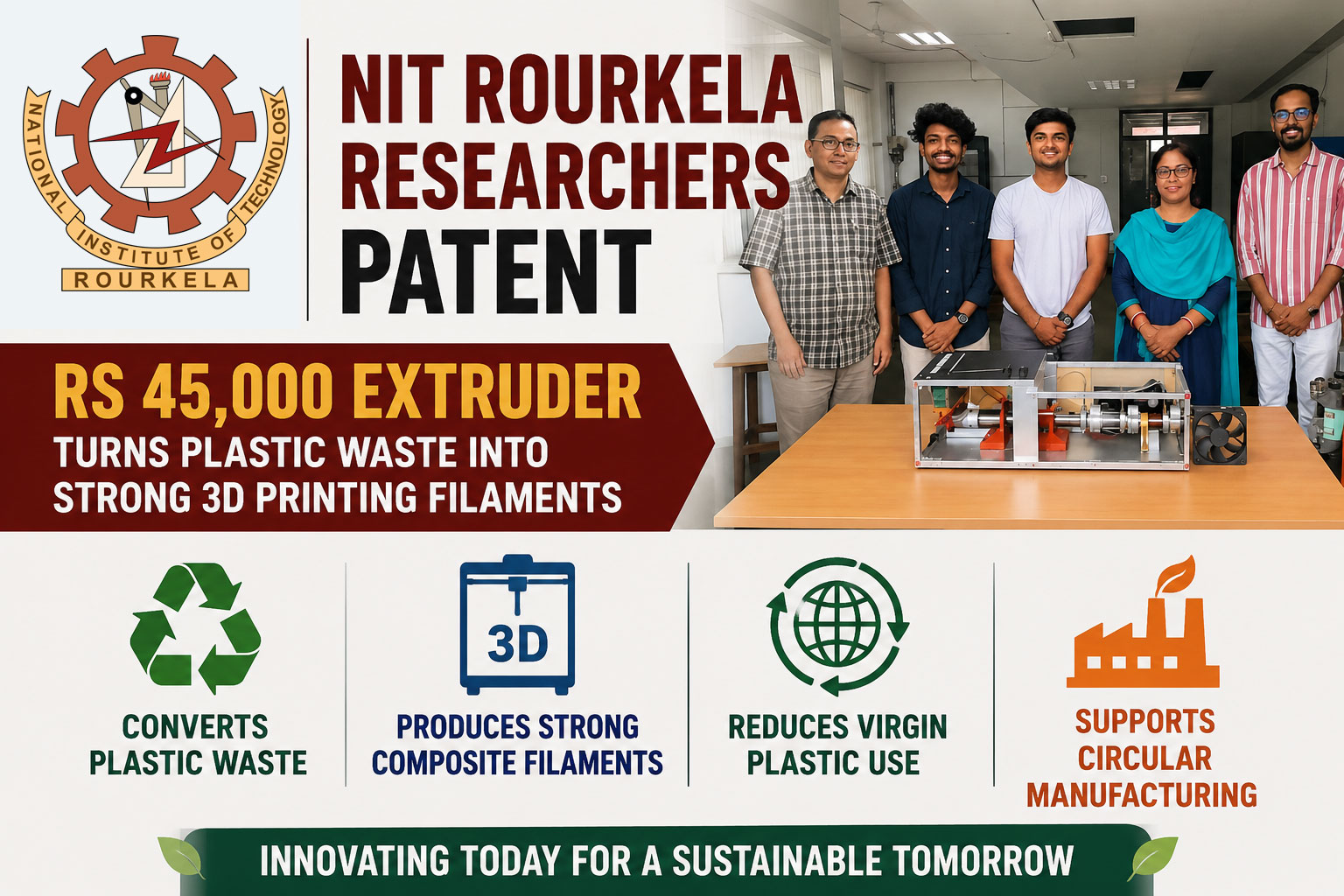
NIT Rourkela researchers patent a Rs 45,000 extruder that converts plastic waste into strong composite filaments for 3D printing, reducing virgin plastic use and supporting circular manufacturing.
Turning plastic waste into 3D-printing material
Researchers at the National Institute of Technology Rourkela (NIT Rourkela) have secured a patent for a low-cost, portable extruder system that produces composite filaments for 3D printing using recycled plastics. The innovation could help reduce dependence on virgin plastic and promote the conversion of plastic waste into value-added products.
Developed at a cost of around Rs 45,000, the system comprises an extruder, a controlled cooling system and PID temperature controllers, among other components. These elements enable precise control over the filament manufacturing process and help ensure consistent diameter, mechanical properties and printability. The patent application for the extrusion system was filed under Application No. 202431068691 on July 30, 2026.
Why recycled filaments matter for 3D printing
Three-dimensional printing is increasingly used in biomedical and engineering applications, including the production of scaffolds, anatomical models, decorative items, brackets, drone components and toys. Fused Deposition Modeling (FDM), one of the most widely used 3D-printing technologies, works by melting thermoplastic filament and depositing it layer by layer to create an object.
However, commercially available thermoplastic filaments can be expensive, while low-quality filaments can compromise print quality and dimensional accuracy. Although researchers worldwide are exploring recycled plastics as a cheaper and more sustainable alternative, their wider use has faced constraints such as processing costs, material wastage, inadequate mechanical strength and limited durability.
The NIT Rourkela team sought to address these challenges through its filament extrusion system, which can combine plastic particles with reinforcement materials to produce filaments with improved strength and durability. By adding fillers or fibres, the researchers can enhance stiffness, toughness and thermal stability compared with filaments made from recycled plastic alone.
How the extruder works
The extrusion system melts recycled plastic particles and mixes them with reinforcement materials before forcing the mixture through a die to form a continuous filament. The controlled cooling system helps the filament solidify uniformly, while PID temperature controllers maintain stable processing conditions.
Laboratory-scale tests showed that the filaments produced using the system had satisfactory mechanical properties and the desired dimensional accuracy. That performance is important because 3D printers require filaments with consistent diameter and predictable behaviour. Variations can lead to clogging, poor layer adhesion or inaccurate dimensions in the final printed part.
Prof Sandhyarani Biswas, Associate Professor in the Department of Mechanical Engineering at NIT Rourkela, said the developed filament extrusion system represents an advancement in filament production technology. She added that the composite filament produced through the extruder can be used for 3D printing of parts with improved mechanical properties for a wide range of applications. The use of recycled plastic in making filament also offers substantial environmental benefits.
Creating a closed loop for plastic waste
Prof Sujit Sen, Professor in the Department of Chemical Engineering at NIT Rourkela, said the system could convert various types of plastic waste into useful 3D-printer filament. That capability could create a sustainable closed-loop system for recycling, reuse and remanufacturing.
Instead of sending plastic waste to landfills or incinerators, communities, institutions and small manufacturers could collect, sort and process it into filament. Schools, colleges, fabrication labs and startups could then use that filament to print prototypes, teaching aids, replacement parts and custom products. The approach supports local circular economies by keeping material within the region and reducing the need for new plastic.
The composite filaments developed through the system could find applications where greater strength and durability are required. Potential uses include functional brackets, drone frames, tool handles, jigs and fixtures, educational models and certain biomedical scaffolds. The exact application will depend on the type of recycled plastic, the reinforcement material and the processing parameters.
Technical and commercial benefits
The researchers said the developed filament extrusion system offers compelling technical and commercial benefits for the 3D-printing industry. On the technical side, it provides better control over filament quality and enables the production of reinforced filaments that are difficult to obtain from standard recycled materials. On the commercial side, the low capital cost makes the system accessible to small enterprises, research labs and educational institutions.
By reducing the cost of filament production, the technology can lower the overall cost of 3D printing. That can encourage wider adoption in sectors such as education, healthcare, small-scale manufacturing and product development. It can also support sustainability goals by diverting plastic waste from disposal streams and replacing some virgin plastic with recycled content.
The research team and next steps
The research team comprises Prof Sandhyarani Biswas, Prof Sujit Sen, Jagdish Uday Khatu, Himanshu Singh and Kiran Suna. The group worked across mechanical and chemical engineering disciplines to design the extruder, optimise processing conditions and evaluate the properties of the resulting filaments.
With the patent secured, the team can now explore licensing opportunities, industry collaborations and technology transfer. Potential partners include filament manufacturers, 3D-printing service bureaus, waste-management companies and institutions that operate large 3D-printing facilities.
Further work may focus on scaling the system, testing additional plastic types and reinforcement materials, and conducting long-term durability studies on printed parts. The researchers may also develop guidelines for sorting and preparing plastic waste to ensure consistent filament quality.
Supporting sustainable 3D-printing practices
The composite filaments developed through the system could support more sustainable 3D-printing practices. By enabling the use of recycled plastics without sacrificing performance, the technology aligns with broader efforts to reduce the environmental footprint of additive manufacturing.
As 3D printing expands into new sectors, the demand for filament will grow. If a significant share of that demand can be met with recycled and reinforced filaments, the industry can reduce its reliance on virgin plastic and lower its overall resource consumption. The NIT Rourkela extruder provides a practical tool to move in that direction.
#NITRourkela #3DPrinting #RecycledPlastic #FilamentExtruder #CompositeFilament #SustainableManufacturing #CircularEconomy #FDM #PlasticWaste #AdditiveManufacturing
Disclaimer
The information in this article is based on available public sources and official statements as of the time of publication. While we aim for accuracy, we do not guarantee completeness or correctness. We advise readers to verify key details from official sources before making any decisions. The website (iitiimsamvaad.com) is not liable for any loss or damage arising from the use of this content. The authors are also not responsible for any such loss or damage.