
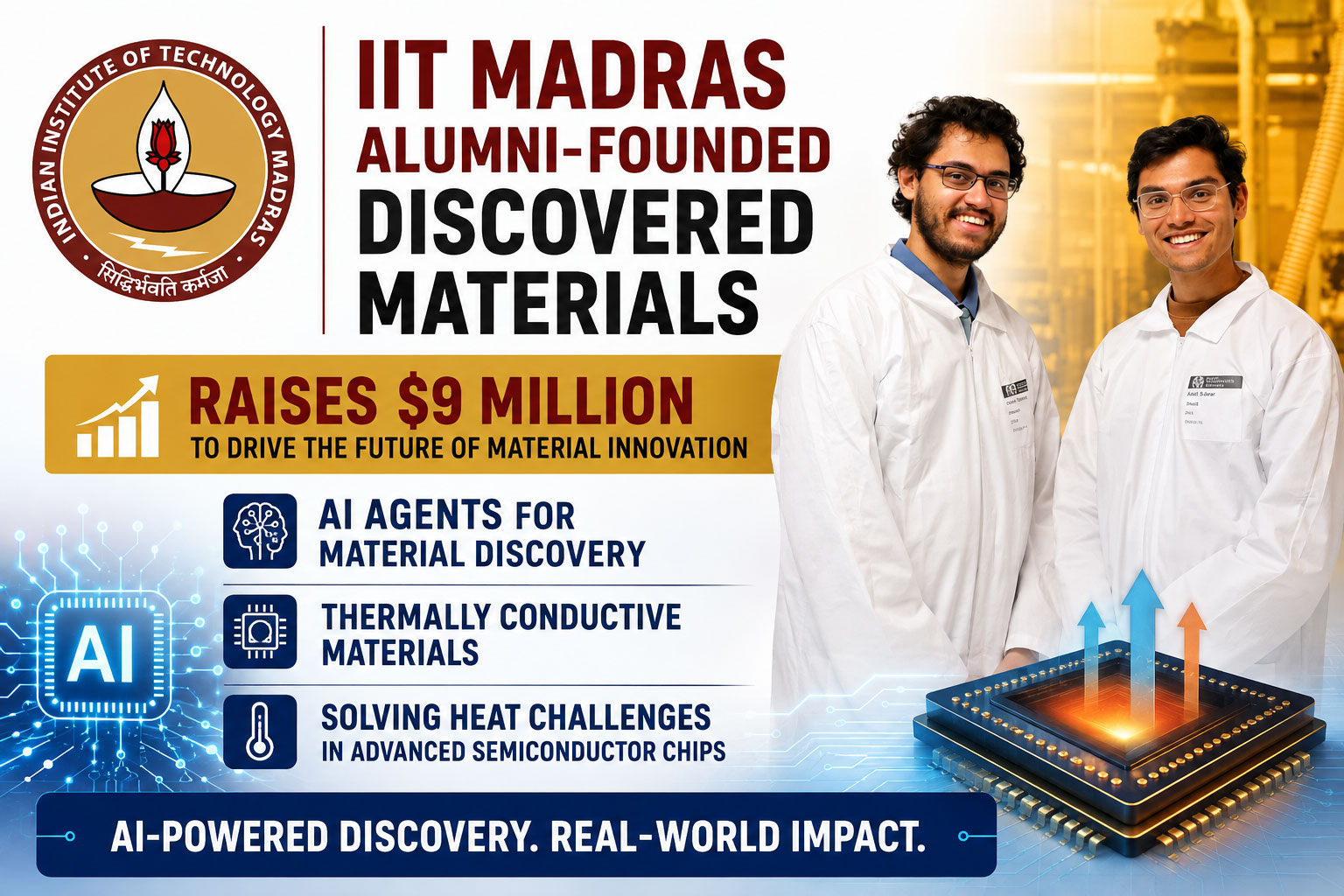
Discovered Materials, founded by IIT Madras alumni, raises $9 million to use AI agents for discovering thermally conductive materials that address heat challenges in advanced semiconductor chips.
Tackling chip heat with AI-driven discovery
Discovered Materials, an AI materials startup founded by IIT Madras alumni, has raised $9 million (about Rs 85 crore) in seed funding to accelerate the development of new materials for semiconductor chips. The funding round was led by Lightspeed, with participation from Y Combinator and Peak XV Partners. Angel investors including Paul Graham, Gokul Rajaram and Thariq Shihipar also joined the round.economictimes.
The San Francisco-based startup plans to use the capital to expand its team and laboratory and to scale the AI agents it uses for materials research. The company aims to compress years of traditional materials research into much shorter timelines by combining autonomous AI agents with computational simulations and experimental validation.
Discovered Materials was founded in 2026 by Advaith Sridhar and Akash Ramdas, who first met more than a decade ago while studying at IIT Madras. Ramdas holds a PhD in materials science from Stanford University and has spent 11 years researching materials for semiconductor chips. Sridhar studied AI at Carnegie Mellon University and previously worked on AI models and agents at Persona AI and Luma Labs.
Why heat management matters for AI chips
The startup is initially focusing on the growing challenge of managing heat in chips used for AI workloads. Modern graphics processing units, or GPUs, must handle heat fluxes of about 140 watts per square centimetre, and thermal demands increase as chips become more powerful. The materials used in a chip influence both the heat it generates and how efficiently that heat can be dissipated.
Advanced 3D chip architectures place components such as memory and logic closer together to improve performance and reduce latency. However, their increased density creates additional challenges in removing heat. If heat cannot escape efficiently, it can limit performance, reduce reliability and increase energy consumption.
Discovered Materials is searching for thermally conductive dielectric materials that could make 3D chip architectures more practical. Such materials must conduct heat effectively while maintaining electrical insulation between layers. Finding the right combination of properties has traditionally required years of experimentation by large chemicals companies.
How AI agents accelerate materials discovery
The startup uses AI agents to propose potential materials and synthesis methods before assessing candidates with computational tools and physics-based simulations. These evaluations examine factors including stability, thermal conductivity and dielectric properties. Only promising candidates move towards laboratory testing.
During its three-month Y Combinator programme, Discovered Materials simulated, synthesised and tested thermal interface materials that matched the performance of products developed over several years by major chemicals companies. The company claims that swarms of AI agents running continuously on cloud infrastructure can explore a much larger design space than traditional research teams.
Akash Ramdas said new materials are how the industry can close the gap between today’s chips and the power efficiency of the human brain. The statement highlights the broader ambition: not just to improve thermal management, but to enable more efficient, powerful and sustainable computing systems.
Material Discovery Bench and open research
Alongside the funding announcement, the startup released Material Discovery Bench, an open-source benchmark intended to test how frontier AI models perform on real-world semiconductor materials problems. The benchmark provides a standardised task for evaluating AI agents on long-horizon materials discovery rather than short question-and-answer tests.
According to the startup, models tested using the benchmark identified more than 500 previously unknown computational material candidates with promising properties. However, finding a candidate in simulation does not guarantee that it can be manufactured or used commercially. Proposed materials still have to undergo synthesis and experimental validation.
That gap between computational discovery and manufacturing remains a significant part of the challenge. AI models may propose chemically unstable compounds, materials that require impractical synthesis conditions, or formulations that cannot integrate with existing chip processes. Discovered Materials aims to bridge this gap by combining AI proposals with physics-based screening and laboratory testing.
Business model and intellectual property
If the startup identifies commercially useful materials, it plans to seek patents covering their use in GPUs or manufacturing processes and license the resulting intellectual property to chipmakers. The company’s business model focuses on licensing and selling IP on the materials it discovers, as well as on the methods used to make them.
This approach allows Discovered Materials to work with multiple semiconductor manufacturers without building its own fabrication facilities. Chipmakers can integrate the new materials into their existing processes, provided the materials meet reliability, cost and compatibility requirements.
The startup’s early focus on thermal interface materials aligns with immediate industry needs. Thermal interface materials sit between chip layers, such as between the silicon die and the metal heat spreader, to fill microscopic surface irregularities and conduct heat outward. Even small improvements in thermal conductivity can translate into better performance and lower cooling costs in data centres.
Broader implications for the semiconductor industry
The funding and the benchmark release signal growing interest in AI-driven materials discovery for semiconductors. As chip performance approaches physical limits, new materials may offer one of the few remaining pathways to significant gains in efficiency and capability.
Discovered Materials’ work also highlights the importance of combining AI with domain expertise. Purely data-driven models may generate chemically unrealistic proposals. By integrating physics-based simulations, synthesis knowledge and experimental validation, the startup aims to produce materials that can move from computation to fabrication.
If successful, the approach could extend beyond thermal materials to other parts of the semiconductor stack, including dielectrics, conductors, barriers and packaging materials. That would position the company as a broader materials discovery platform rather than a single-product vendor.
From IIT Madras to global semiconductor innovation
The founders’ journey from IIT Madras to Stanford, Carnegie Mellon and leading AI labs reflects the global nature of deep-tech innovation. Their collaboration combines materials science expertise with advanced AI agent development.
The $9 million seed round provides the resources to scale that collaboration. With additional funding, the team can expand its laboratory capacity, hire more researchers and run larger-scale experiments. It can also deepen partnerships with chipmakers, chemicals companies and research institutions.
As AI infrastructure continues to grow, heat management will remain a critical bottleneck. Discovered Materials aims to address that bottleneck at the materials level, using AI to discover solutions that traditional research methods might miss.
#DiscoveredMaterials #IITMadras #SemiconductorMaterials #AIForMaterials #ChipHeatManagement #ThermalInterfaceMaterials #YCombinator #DeepTech #MaterialsDiscovery #LightspeedIndia
Disclaimer
The information in this article is based on available public sources and official statements as of the time of publication. While we aim for accuracy, we do not guarantee completeness or correctness. We advise readers to verify key details from official sources before making any decisions. The website (iitiimsamvaad.com) is not liable for any loss or damage arising from the use of this content. The authors are also not responsible for any such loss or damage.