
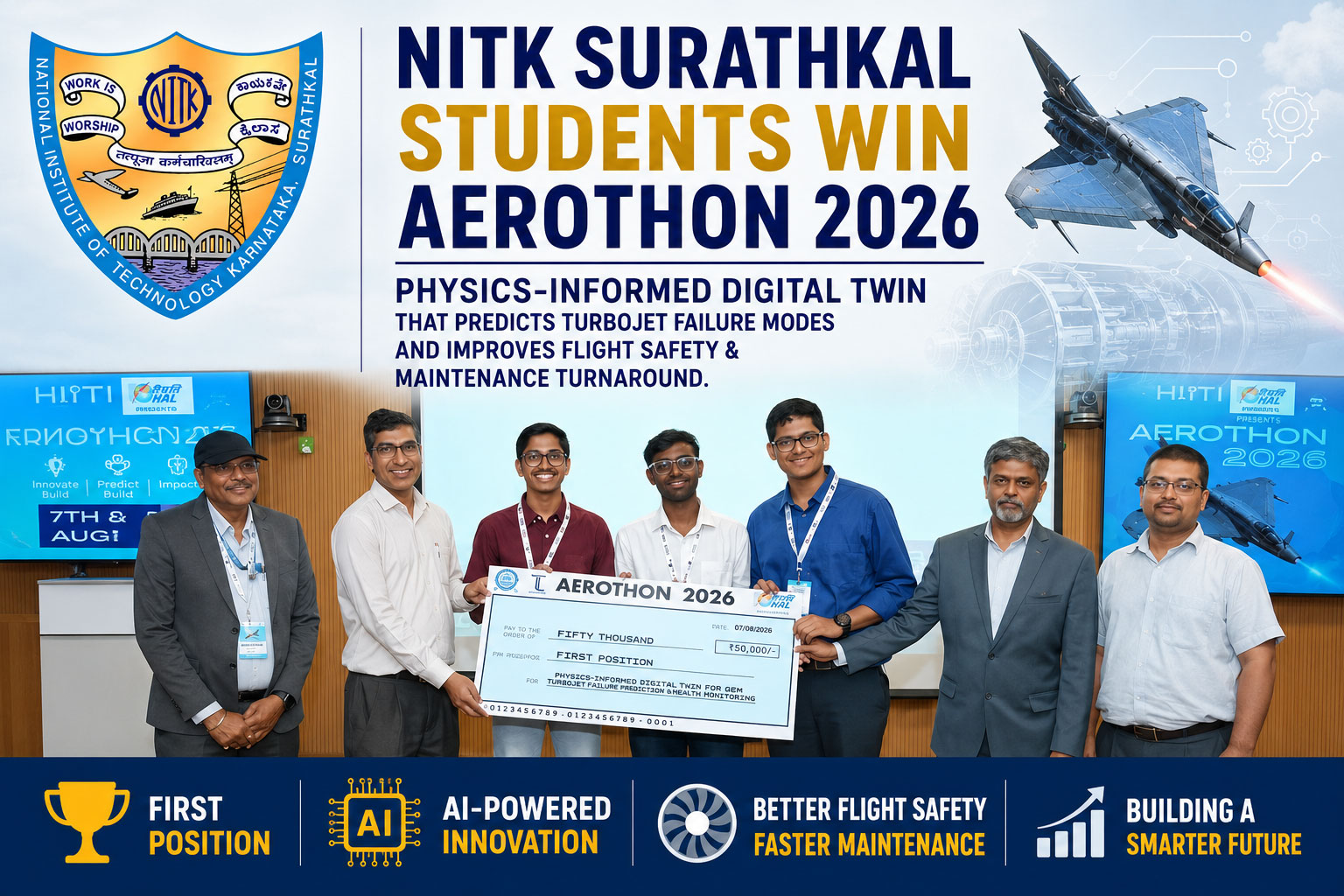
NITK Surathkal students win Aerothon 2026 with a physics-informed digital twin that predicts turbojet failure modes and improves flight safety and maintenance turnaround.
A national win for NITK Surathkal
A four-member student team from the National Institute of Technology Karnataka (NITK), Surathkal, has won first place at Aerothon 2026, a national aerospace hackathon organised by Hindustan Aeronautics Limited (HAL) and IIT Indore. The team competed against more than 640 teams from across the country and emerged as the overall winner.
The winning team comprised Omkar Kharade and Shubham Shah, pre-final-year mechanical engineering students; Diya Taneja, a pre-final-year electronics and communication engineering student; and Maxon David Nazareth, a second-year mechanical engineering student. The students were among 20 finalist teams selected for a 24-hour hackathon held at IIT Indore on August 7 and 8. They received a cash prize of Rs 50,000 for their achievement.
Aerothon 2026 attracted more than 2,300 participants and challenged them to develop data-driven, machine-learning solutions to real-world aerospace engineering problems. The competition brought together students, researchers and innovators from engineering colleges and universities across India.
The problem statement and solution
The NITK team developed a solution for the problem statement, “Physics-Informed Digital Twin for Real-Time Four-Stage Turbojet Health Monitoring”. The system processes real-time sensor data from a turbojet engine and uses machine learning to predict specific failure modes before they occur.
A digital twin acts as a virtual replica of a physical system. In this case, the team built a software model that mirrors the behaviour of a four-stage turbojet engine. The model receives live sensor inputs such as temperature, pressure, vibration and rotational speed. It then compares the current operating data with historical performance baselines and known failure patterns.
By combining physics-based models with machine learning, the system can identify early signs of degradation or abnormal behaviour. It can flag potential issues such as compressor stalls, turbine blade fatigue, bearing wear or fuel-system anomalies. Maintenance teams can then inspect or replace components before a failure leads to an in-flight incident or an unscheduled grounding.
Why digital twins matter in aerospace
Digital twins have become an important tool in modern aerospace engineering. They allow manufacturers, operators and maintenance providers to monitor the health of aircraft and engines in real time. Instead of relying only on scheduled inspections or reactive repairs, organisations can move towards predictive maintenance.
Predictive maintenance can improve flight safety by reducing the risk of unexpected engine failures. It can also lower operating costs by minimising unscheduled downtime and optimising spare-parts inventory. Airlines can plan maintenance during regular layovers rather than facing emergency repairs. Engine manufacturers can use the data to improve future designs and identify recurring issues across fleets.
The NITK team’s solution aligns with this broader industry trend. By focusing on a four-stage turbojet, the students addressed a realistic configuration used in training aircraft, unmanned aerial vehicles and small propulsion systems. The approach can potentially scale to more complex engines with additional stages and subsystems.
From hackathon to real-world impact
The team designed its solution to improve flight safety and reduce turnaround time for engine manufacturers, maintenance providers and airlines. The system could help ground crews prioritise inspections, reduce unnecessary teardowns and avoid premature component replacements.
The students now plan to develop the project further for possible commercialisation. They are seeking support from NITK alumni and industry experts in aerospace and aviation sectors. Mentorship from experienced engineers could help them refine the model, validate it against real engine data and explore integration with existing maintenance software.
Further development may include testing the system on benchmark datasets, collaborating with research groups that work on propulsion health monitoring, and engaging with startups or companies in the aerospace supply chain. The team may also explore intellectual property protection and potential licensing opportunities.
A multidisciplinary effort
The composition of the team reflects the multidisciplinary nature of aerospace systems. Mechanical engineering students contributed knowledge of propulsion, thermodynamics and engine components. The electronics and communication engineering student brought expertise in sensors, signal processing and data acquisition.
Such collaboration mirrors real industry projects, where engineers from different disciplines work together to solve complex problems. The hackathon format also tested the students’ ability to divide tasks, manage time and deliver a working prototype under pressure.
Their success demonstrates that undergraduate students can contribute meaningfully to advanced engineering challenges when they receive the right problem statement, mentorship and platform. Aerothon 2026 provided that platform by connecting students with HAL, IIT Indore and a national audience.
NITK’s growing innovation footprint
The win adds to NITK Surathkal’s growing record of student innovation in technology and engineering. The institute has participated in national and international competitions in robotics, artificial intelligence, sustainable design and aerospace.
The victory may also encourage more students to take up aerospace-related projects, internships and research. It can strengthen collaborations between the institute and organisations such as HAL, ISRO, DRDO and private aerospace companies.
For coastal Karnataka, the achievement supports the broader “Silicon Beach” vision of building a technology and innovation ecosystem in the region. Student teams that succeed in national competitions can attract attention from investors, incubators and industry partners.
Next steps for the team
The NITK team will now focus on refining its digital twin model and expanding its capabilities. They may incorporate additional sensor inputs, improve the accuracy of failure predictions and test the system on more diverse operating conditions.
They may also explore how the solution can integrate with existing maintenance workflows. Airlines and maintenance organisations use software platforms to track engine health, schedule inspections and manage parts. A digital twin that can feed into these systems could provide actionable insights rather than standalone predictions.
The students’ journey from a national hackathon to a potentially commercialisable product will depend on continued mentorship, access to data and validation in realistic environments. Their Aerothon win provides a strong starting point for that journey.
#NITKSurathkal #Aerothon2026 #DigitalTwin #AerospaceEngineering #PredictiveMaintenance #TurbojetEngine #MachineLearning #HAL #IITIndore #StudentInnovation
Disclaimer
The information in this article is based on available public sources and official statements as of the time of publication. While we aim for accuracy, we do not guarantee completeness or correctness. We advise readers to verify key details from official sources before making any decisions. The website (iitiimsamvaad.com) is not liable for any loss or damage arising from the use of this content. The authors are also not responsible for any such loss or damage.