
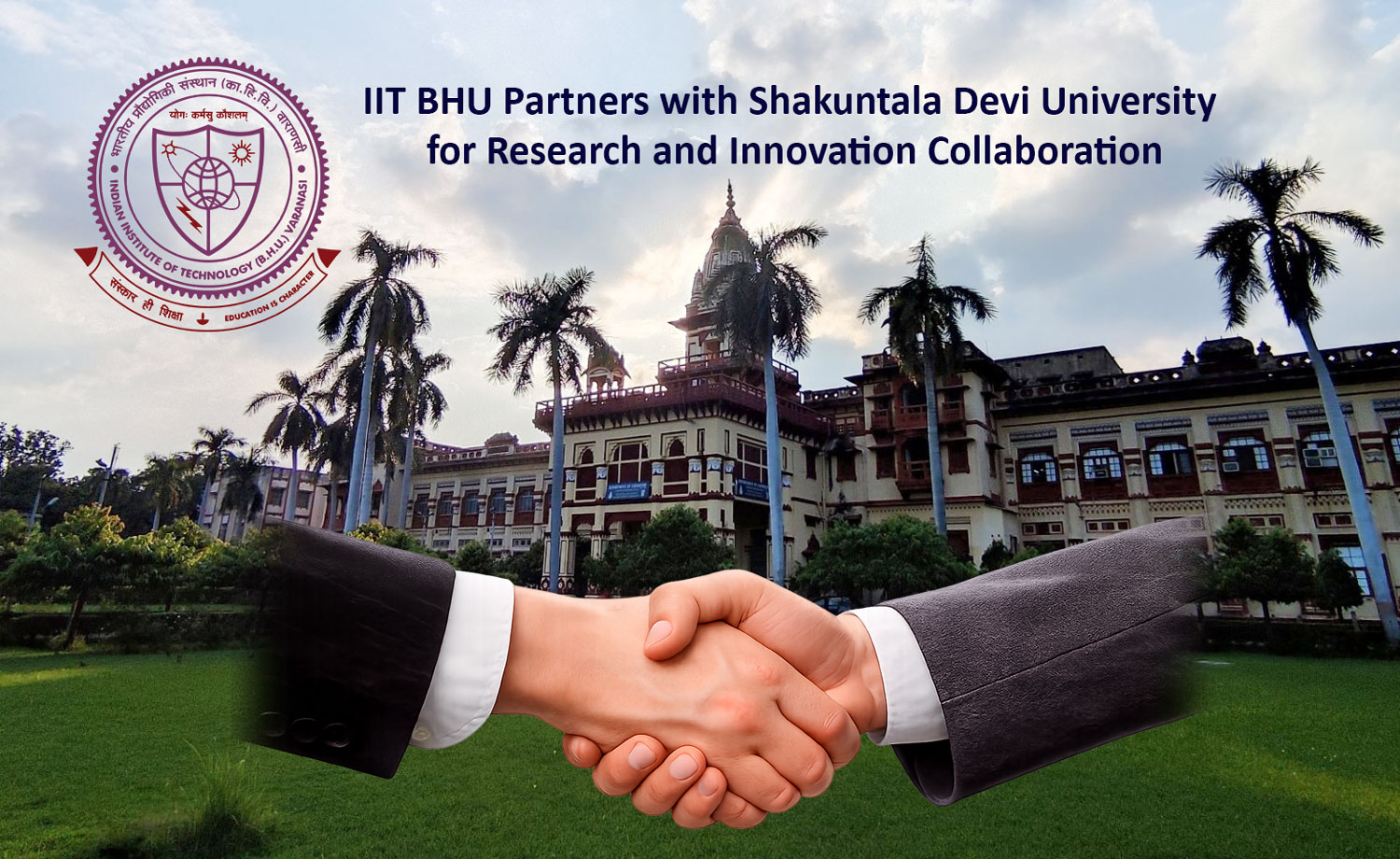
IIT BHU Partners with Shakuntala Devi University for Research and Innovation Collaboration
IIT BHU signs MoU with Dr. Shakuntala Devi University, Lucknow, to advance joint research, student exchanges, and interdisciplinary innovation initiatives.
IIT (BHU) signed a significant Memorandum of Understanding (MoU) with Dr Shakuntala Devi University in Lucknow on Monday. This marked a strategic alliance to enhance academic cooperation, research collaboration, and innovation-driven initiatives. The ceremony was attended by IIT-BHU Director Prof Amit Patra, Dr Shakuntala Devi University Vice Chancellor Prof Sanjay Singh, and Prof Vijay Shankar Sharma. This represents a formal commitment to shared academic excellence and mutual growth. This partnership builds on prior institutional interactions and leadership visits that laid the groundwork for joint academic and research activities.
Strategic Academic Partnership for Shared Growth
The dignitaries emphasized that the MoU launches a long-term academic association rooted in shared vision and collaborative innovation. Prof Amit Patra highlighted the complementary strengths of both institutions. IIT BHU’s strength is engineering and technology leadership. Whereas Shakuntala Devi University’s focus on mathematical sciences, computational innovation, and interdisciplinary applications. “This collaboration creates synergies that multiply research impact and educational outcomes,” Prof Patra stated during the address.
Dr Shakuntala Devi University, named after India’s “Human Computer” renowned for mathematical genius, brings specialized expertise in computational mathematics, AI algorithms, cryptography, and data sciences. IIT BHU contributes world-class engineering research, advanced laboratories, and industry partnerships. The MoU formalizes their ambition to address complex technological challenges through combined intellectual capital.
Comprehensive Collaboration Framework
The partnership encompasses joint research and development projects where faculty teams will collaborate on cutting-edge R&D. Teams will be targeting AI-driven mathematical modeling, quantum computing algorithms, sustainable engineering solutions, and computational biology. This will include co-authored publications and joint patent filings amplifying research visibility and IP generation. Faculty and student exchange programmes will include short-term visiting faculty appointments and semester-long student exchanges. This will expose participants to diverse academic environments, where IIT BHU students gain mathematical computation expertise and Shakuntala Devi University students access engineering applications and industry projects.
Both institutions will co-organize workshops, conferences, and training programmes including national symposia on computational innovation, mathematical engineering, and Industry 4.0 applications, alongside executive training programmes targeting corporate R&D leaders that generate revenue while enhancing brand visibility. Skill development and capacity building efforts feature joint certification programmes in AI, data science, computational finance, and smart manufacturing addressing industry skill gaps, with bootcamps and hackathons nurturing startup talent leveraging IIT BHU’s Incubation Centre and Shakuntala Devi University’s mathematical innovation focus.
Interdisciplinary innovation targets collaborative centres addressing societal challenges like smart cities, renewable energy optimization, and healthcare diagnostics. This will help merging mathematical modeling with engineering execution for breakthrough solutions.
Leveraging Complementary Institutional Strengths
IIT BHU, consistently ranked among India’s top 10 engineering institutes, offers state-of-the-art laboratories, corporate partnerships with Tata, Reliance, DRDO, and global research collaborations. Its entrepreneurial ecosystem has spawned 50+ deep-tech startups since 2018. Dr Shakuntala Devi University specializes in computational mathematics applications across finance, cryptography, AI, and computational physics. This attracts mathematical talent nationwide with faculty including Fields Medal contenders and computational pioneers.
Expected Research and Innovation Outcomes
The partnership targets measurable impact within three years, including 15+ joint research publications in top-tier journals like IEEE, ACM, and Nature Computational Science, 10+ co-developed technologies with commercialization potential, 500+ students participating in exchange programmes and skill workshops, 5+ joint startups incubated through combined mentorship and funding networks, and ₹10 crore+ research grants secured through collaborative proposals to DST, DBT, and MeitY. Industry relevance remains paramount as joint projects with PSUs, defence organizations, and MNCs translate academic research into deployable solutions. This will position both institutions to capture India’s $100 billion AI and advanced computing market by 2030.
Regional and National Significance
The MoU strengthens Uttar Pradesh’s innovation ecosystem as Lucknow emerges as an education hub alongside IIT Kanpur and IIM Lucknow, benefiting from IIT BHU’s spillover expertise. Varanasi’s transformation into a technology destination gains mathematical computing prowess. Nationally, the partnership exemplifies second-generation IITs expanding interdisciplinary alliances, addressing India’s engineering education critique of strong technical skills lacking computational sophistication, producing graduates blending mathematical rigor with engineering execution.
Long-term Vision for Collaborative Excellence
Prof Sanjay Singh emphasized sustained commitment: “This MoU transforms institutional boundaries into shared opportunity spaces.” Prof Vijay Shankar Sharma highlighted societal impact: “Computational innovation solves India’s unique challenges – population-scale optimization, resource allocation, climate modeling.” Both institutions plan permanent joint research centres by 2028 targeting national missions like Digital India, Smart Cities, and National Quantum Mission, with annual innovation summits maintaining momentum.
Academic Excellence Through Strategic Alliances
This collaboration exemplifies modern higher education strategy – breaking disciplinary silos through strategic partnerships. IIT BHU gains mathematical computation leadership; Shakuntala Devi University accesses engineering infrastructure and industry networks. Students benefit from diverse mentorship; faculty gain collaborative research bandwidth; society receives innovative solutions. The MoU positions both institutions at India’s technological frontier, ready to power the nation’s $5 trillion economy ambition through computational-engineering fusion. As Prof Patra concluded, “Together, we don’t just educate leaders – we engineer India’s computational future.”
Disclaimer
The information in this article is based on available public sources and official statements as of the time of publication. While we aim for accuracy, we do not guarantee completeness or correctness. We advise readers to verify key details from official sources before making any decisions. The website (iitiimsamvaad.com) is not liable for any loss or damage arising from the use of this content. The authors are also not responsible for any such loss or damage.