
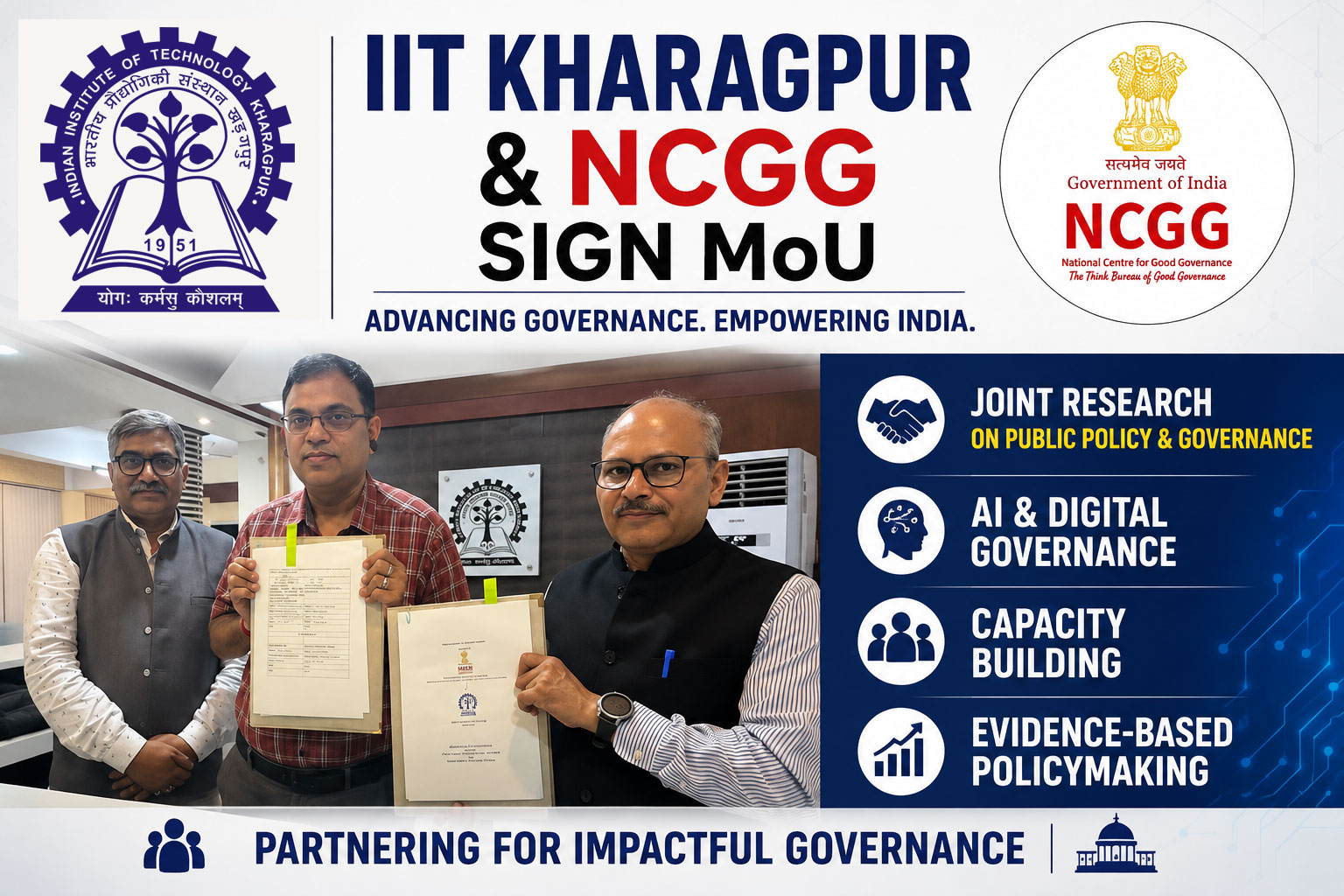
IIT Kharagpur and NCGG sign MoU to collaborate on public policy, governance, AI and digital governance through joint research, capacity building and evidence-based policymaking.
A strategic partnership for governance
The Indian Institute of Technology Kharagpur has signed a Memorandum of Understanding (MoU) with the National Centre for Good Governance (NCGG), Government of India, to strengthen collaboration in public policy research, capacity building and evidence-based governance. The agreement aims to combine academic expertise with governance experience to support better policymaking, stronger institutions and more effective public administration.
Prof Suman Chakraborty, Director of IIT Kharagpur, and Dr Surendrakumar Bagde, IAS, Director General of NCGG, signed the MoU in the presence of Prof Uday Shankar, Dean of the Rajiv Gandhi School of Intellectual Property Law (RGSOIPL). The signing took place during the 2nd Annual Public Policy & Law Conference, highlighting the institute’s growing engagement with policy and governance alongside its traditional strengths in science, technology and engineering.
Institutional framework for collaboration
The partnership involves IIT Kharagpur’s Centre of Excellence in Public Policy, Law and Governance (CoEPPLG) and RGSOIPL. These units will work closely with NCGG on joint capacity-building programmes, faculty and resource exchange, collaborative research, consultative conclaves and policy innovation.
The collaboration will focus on emerging policy areas including Digital Governance, AI Governance, Public Economics, Infrastructure and Energy Policy, and Global Trade Policy. These themes reflect the changing nature of governance in a technology-driven economy. As governments adopt digital platforms, data analytics and artificial intelligence, they need robust frameworks for regulation, accountability, ethics and public value creation.
Through the partnership, IIT Kharagpur and NCGG aim to bridge the gap between academic research and practical governance. Faculty members, researchers and students can work on real policy challenges, while civil servants and policymakers can access analytical tools, evidence and interdisciplinary perspectives.
Why AI and digital governance matter
AI and digital governance have become central to public administration worldwide. Governments use algorithmic systems for service delivery, fraud detection, resource allocation and risk assessment. At the same time, these technologies raise questions about bias, transparency, privacy, accountability and the distribution of benefits and risks.
The MoU positions IIT Kharagpur and NCGG to contribute to these debates. Researchers can study how AI systems affect public services, propose regulatory approaches and develop guidelines for responsible deployment. They can also examine how digital infrastructure, data governance and cybersecurity influence trust in government and the quality of public services.
Infrastructure and energy policy form another important area. India’s transition to cleaner energy, expansion of transport networks and development of smart cities require coordinated policy action. Public economics and global trade policy add further dimensions, as governments balance domestic priorities with international commitments and market dynamics.
Capacity building and faculty exchange
Joint capacity-building programmes will allow civil servants, researchers and students to learn from one another. NCGG already runs training programmes for officers from India and other countries. The collaboration with IIT Kharagpur can enrich these programmes with technical expertise, data-driven analysis and interdisciplinary insights.
Faculty and resource exchange will enable academics to spend time within government institutions and policymakers to engage with university research. Such interaction helps researchers understand the constraints and realities of policy implementation. It also helps officials access cutting-edge research and analytical methods.
Consultative conclaves and policy innovation forums can bring together scholars, practitioners and stakeholders to discuss specific challenges. These events can generate policy briefs, white papers and recommendations that inform decision-making. Over time, they can build a community of practice around evidence-based governance.
Evidence-based policymaking
A central goal of the partnership is to support evidence-based policymaking. Instead of relying only on intuition or political considerations, governments can use data, analysis and evaluation to design and refine policies. IIT Kharagpur’s strengths in engineering, data science, economics and law can contribute to this effort.
Researchers can help design pilot programmes, evaluate interventions and measure outcomes. They can also develop models to assess the impact of policy changes on different groups. Such work can improve the effectiveness of public spending, reduce unintended consequences and enhance accountability.
NCGG’s experience in governance training and policy research complements IIT Kharagpur’s academic capabilities. Together, the institutions can produce research that is both rigorous and relevant to real-world governance challenges.
Strengthening public policy at IIT Kharagpur
The MoU builds on IIT Kharagpur’s existing work in public policy, law and governance. The institute offers a Master’s in Public Policy, Law and Governance (MPPLG) and hosts CoEPPLG as a hub for interdisciplinary research. RGSOIPL contributes expertise in intellectual property, technology law and legal frameworks for innovation.
The partnership with NCGG can enhance these programmes by providing access to government data, case studies and practitioners. Students can work on live policy problems, intern with government agencies and participate in policy labs. Faculty can collaborate on research projects and publish jointly with NCGG scholars.
The collaboration also signals IIT Kharagpur’s broader ambition to contribute to national development beyond technology and engineering. By engaging with public policy and governance, the institute can help shape how India adopts new technologies, manages public resources and designs institutions for the future.
A model for academia–government collaboration
The IIT Kharagpur–NCGG partnership can serve as a model for other institutions. It shows how technical universities can contribute to governance by combining analytical rigour with policy relevance. It also demonstrates how government agencies can benefit from academic research without compromising operational priorities.
As India faces complex challenges in digital transformation, climate change, healthcare, education and economic development, such collaborations will become increasingly important. The MoU provides a structured framework for sustained engagement rather than one-off projects.
If implemented effectively, the partnership can produce research, training programmes and policy recommendations that improve public governance. It can also inspire other IITs, NITs and universities to develop similar ties with government institutions.
#IITKharagpur #NCGG #PublicPolicy #GovernanceResearch #AIGovernance #DigitalGovernance #EvidenceBasedPolicy #CoEPPLG #RGSOIPL #CapacityBuilding
Disclaimer
The information in this article is based on available public sources and official statements as of the time of publication. While we aim for accuracy, we do not guarantee completeness or correctness. We advise readers to verify key details from official sources before making any decisions. The website (iitiimsamvaad.com) is not liable for any loss or damage arising from the use of this content. The authors are also not responsible for any such loss or damage.